
In 1967, a 24-year-old PhD student detected a mysterious signal in the sky.
They were pulsars, rapidly spinning neutron stars.
A major discovery later rewarded with a Nobel
Prize… that she never received.
The story of Jocelyn Bell Burnell perfectly illustrates the Matilda
Effect, the invisibilization of women scientists.
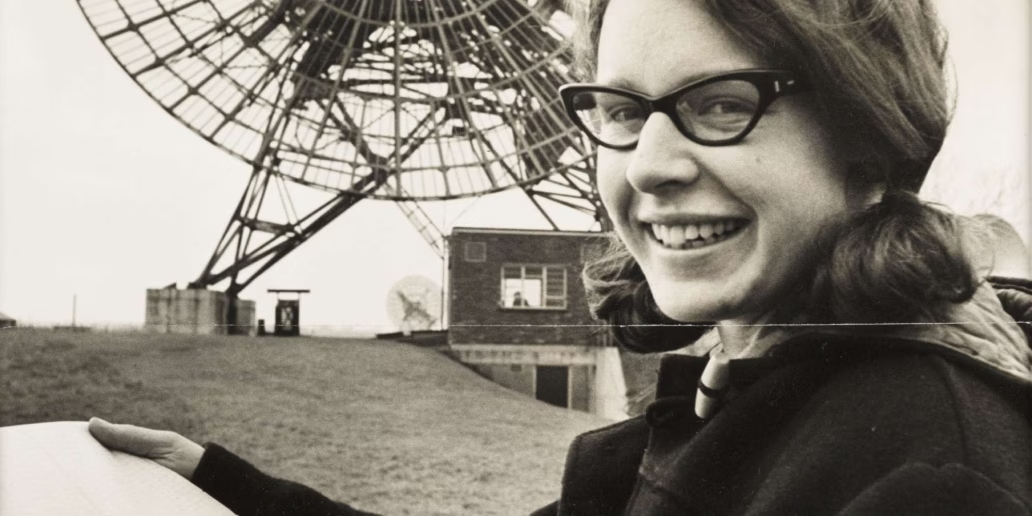
Photograph of Jocelyn Bell Burnell at the Cambridge Radio Astronomy Laboratory
A brilliant student facing the universe
While completing her doctorate at the University of Cambridge, Jocelyn
Bell Burnell spent hours analyzing miles of radio telescope charts she had helped build.
That’s
when she noticed a regular, precise signal — neither a normal star nor a technical error.
It
was a neutron star rotating at incredible speed: a pulsar.
Her intuition and scientific rigor
led to one of the most important discoveries in modern astrophysics.
When recognition slips away
In 1974, the Nobel Prize in Physics was awarded to Antony Hewish and
Martin Ryle, her supervisors, for the discovery of pulsars.
Jocelyn Bell Burnell’s name wasn’t
even mentioned.
This injustice became a symbol of structural sexism in science.
“It would be dishonest to say I wasn’t disappointed. But I knew how things worked back then.”
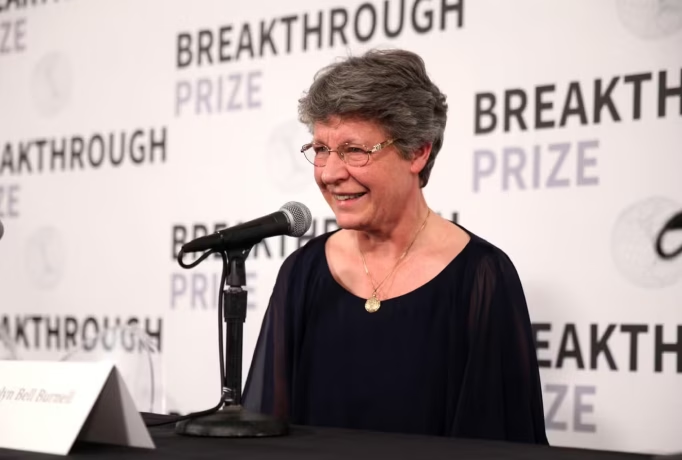
“The stars don’t care who discovers them.” — Jocelyn Bell Burnell
A fight for future generations
Far from bitterness, Jocelyn Bell Burnell dedicated her career to
encouraging young women to pursue science.
In 2018, after receiving the Breakthrough Prize, she
donated the entire reward to fund scholarships for women and minorities in physics.
“If my story can inspire a young woman to believe in her place in science, then that’s a victory.”
By Valentin DEROO, MMI student
Published on 20/10/2025